

Medical Billing Clearinghouse Solutions
Electronic claims submission and clearinghouse services that scrub claims before payer submission, identify errors early, and accelerate clean claim rates.
What a Clearinghouse Does in the Claim Path
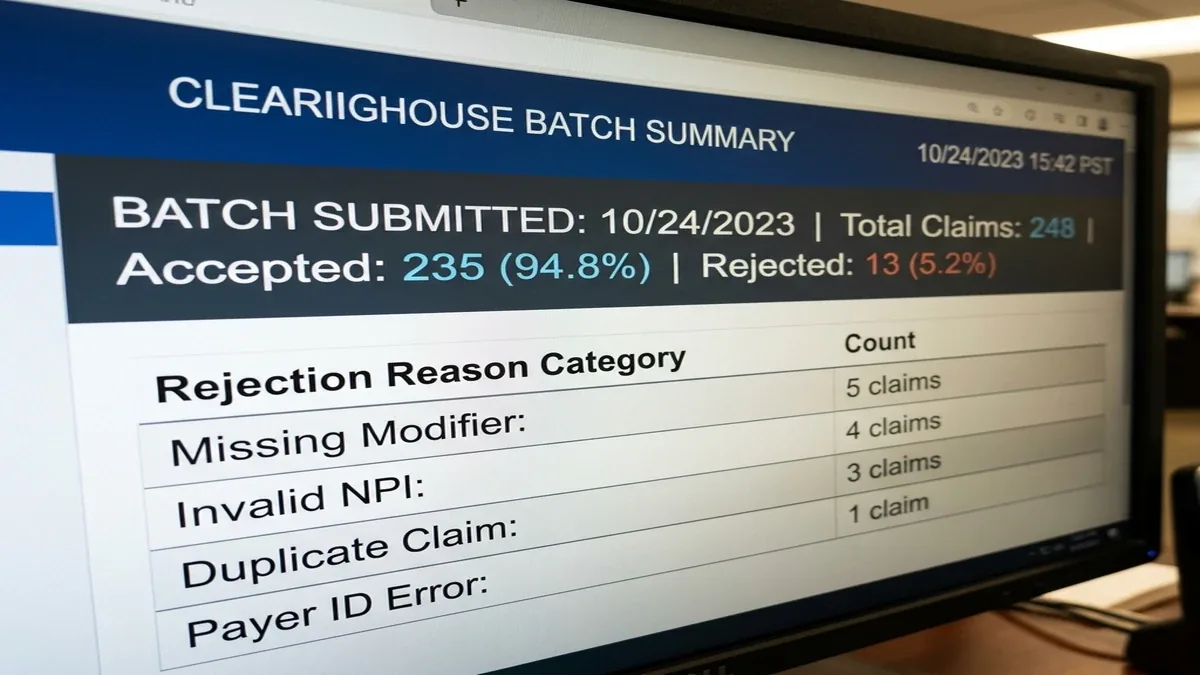
The clearinghouse sits between your billing system and the payer, validating claim format and payer-specific requirements before transmission. Claims rejected at this stage never reach the payer at all, which is why unmonitored clearinghouse rejections are a common source of silently lost revenue.
- Claims validated against payer edits before they are transmitted
- Front-end rejections caught and corrected in the same cycle
- Acknowledgements reconciled so nothing sits unnoticed as submitted
- Electronic remittance routed back for automated posting
Clearinghouse Solutions Explained
A medical billing clearinghouse is the electronic hub between a provider's billing system and payers. It receives claim files, validates them against payer-specific edit rules, identifies errors before submission, and routes clean claims to the correct destination. Without a clearinghouse layer, billing errors reach payers and become formal rejections that delay payment and require manual rework. HIPAA mandates that all covered entities submit claims in standardized EDI format, which the clearinghouse enforces before transmission.
Medsure RCS uses established clearinghouse connections that provide real-time claim status, rejection analytics, and edit reports. Our team reviews clearinghouse output daily to catch and correct any claim issues before they age or expire. All validated claims flow directly into our electronic claims submission workflow so nothing stalls between scrubbing and payer delivery. Claims that fail clearinghouse edits or are rejected after submission are escalated to denial management, while adjudicated payments flow to payment posting.
How It Works: Step by Step
Claim File Submission
Claims are exported from the practice management system and submitted electronically to the clearinghouse in HIPAA-compliant EDI 837P or 837I format.
Clearinghouse Edit Validation
The clearinghouse applies payer-specific edit rules to check for missing fields, incorrect codes, mismatched identifiers, and HIPAA compliance issues.
Rejection Review and Correction
Claims flagged by clearinghouse edits are reviewed by our team, corrected at the source, and resubmitted the same day wherever possible.
Real-Time Status Tracking
Submitted claims are tracked through clearinghouse acknowledgment and payer acceptance status so nothing sits unconfirmed for more than 24 hours.
Why This Matters for Your Revenue Cycle
Clearinghouse acknowledgments confirm acceptance or rejection within 24 hours of submission.
Pre-submission edit checks drive the majority of claims through to payer receipt without rejection.
Clearinghouse rejections are reviewed and corrected within one business day to minimize payment delays.
All claims are submitted in current HIPAA-compliant EDI format matched to each payer's specifications.
Common Mistakes in Clearinghouse Solutions
Confusing Rejections with Denials
Clearinghouse rejections happen before a claim reaches the payer and can be corrected and resubmitted without starting the denial appeal process. Denials occur after payer adjudication. Treating them the same way wastes time and delays payment.
Not Reviewing Clearinghouse Reports Daily
Claims rejected at the clearinghouse stay unsubmitted until someone reviews the rejection report and acts on it. Daily clearinghouse monitoring is required to prevent submission gaps that allow timely filing windows to close.
Using Outdated EDI Specifications
Payer EDI specifications change. Claims submitted in outdated formats are rejected at the clearinghouse level before ever reaching the payer, and the errors are not always self-explanatory.
Skipping Claim Scrubbing Before Submission
Submitting claims without pre-submission scrubbing sends avoidable errors to the clearinghouse and then to payers, increasing rejection rates and delaying payment cycles.
How Medsure RCS Manages Clearinghouse Solutions
EDI 837P and 837I Submission
We submit professional (CMS-1500) and institutional (UB-04) claims in correct EDI format with all required data elements populated per payer specifications.
Daily Rejection Report Review
Clearinghouse rejection reports are reviewed every business day, and identified errors are corrected and resubmitted before timely filing windows become a concern.
Real-Time Submission Tracking
Claim status is tracked from submission through clearinghouse acceptance and payer acknowledgment, with alerts for any claims that stall at any stage.
Payer-Specific Edit Rule Application
Our clearinghouse connections apply the most current payer-specific edit rules, reducing the rate of front-end rejections before claims reach payer review.
Related Services
Clearinghouse Solutions, Frequently Asked Questions
We use established clearinghouse connections compatible with your existing EHR and practice management system. We can work with Availity, Change Healthcare, Waystar, and other major clearinghouses.
A rejection occurs at the clearinghouse before the claim reaches the payer and means the claim file had a format or data error. A denial occurs after payer review and means the payer received the claim but declined to pay it for a clinical or coverage reason. They require different responses.
We target same-day or next-business-day correction and resubmission for clearinghouse rejections so claims do not age out of timely filing windows.
Yes. We track rejection reason codes by payer and claim type to identify systemic issues at the billing or coding level that require upstream correction.
Ask About Clearinghouse Solutions
Ready to Improve Your Clearinghouse Solutions?
Talk to a Medsure RCS specialist. No commitment, no pressure, just answers.
Sign up for our newsletter to receive updates, industry news, and articles about medical billing and revenue cycle management.