

Pain Management Billing Services
Pain management billing services for interventional procedures, spinal injections, nerve blocks, and pain management E/M encounters.
Why Pain Management Claims Get Scrutinised
Interventional pain procedures attract close review because volume and cost are both high. Authorization is required for most interventions, imaging guidance is frequently bundled, and repeat procedures need documented response to the previous one.
- Authorization obtained before interventional procedures
- Imaging guidance billed or bundled per the specific procedure
- Repeat procedures supported by documented prior response
- Device implantation and management reported separately
Pain Management Billing Services Explained
Pain management billing is procedure-intensive, with high prior authorization requirements and complex imaging guidance billing rules. Spinal injection codes vary by injection type, approach, agent, and spinal level, and are subject to NCCI bundling edits when imaging-guided placement is performed. Commercial payers and Medicare Advantage plans require authorization for the majority of interventional procedures. Where those interventions become surgical, the global period rules described under neurosurgery billing apply instead.
Medsure RCS manages pain management medical billing services for interventional and comprehensive pain practices across Florida. We handle the full range of injection and implant codes, manage authorization workflows for procedure-intensive practices, and use denial management workflows to recover any claims denied for missing authorization or documentation gaps. Pain management is part of our specialty medical billing program. Image guidance is billed separately where it applies, such as 77001.
How It Works: Step by Step
Authorization Pre-Clearance
Prior authorization requests are submitted for all scheduled interventional procedures requiring payer approval, with clinical documentation supporting medical necessity.
Procedure and Guidance Code Selection
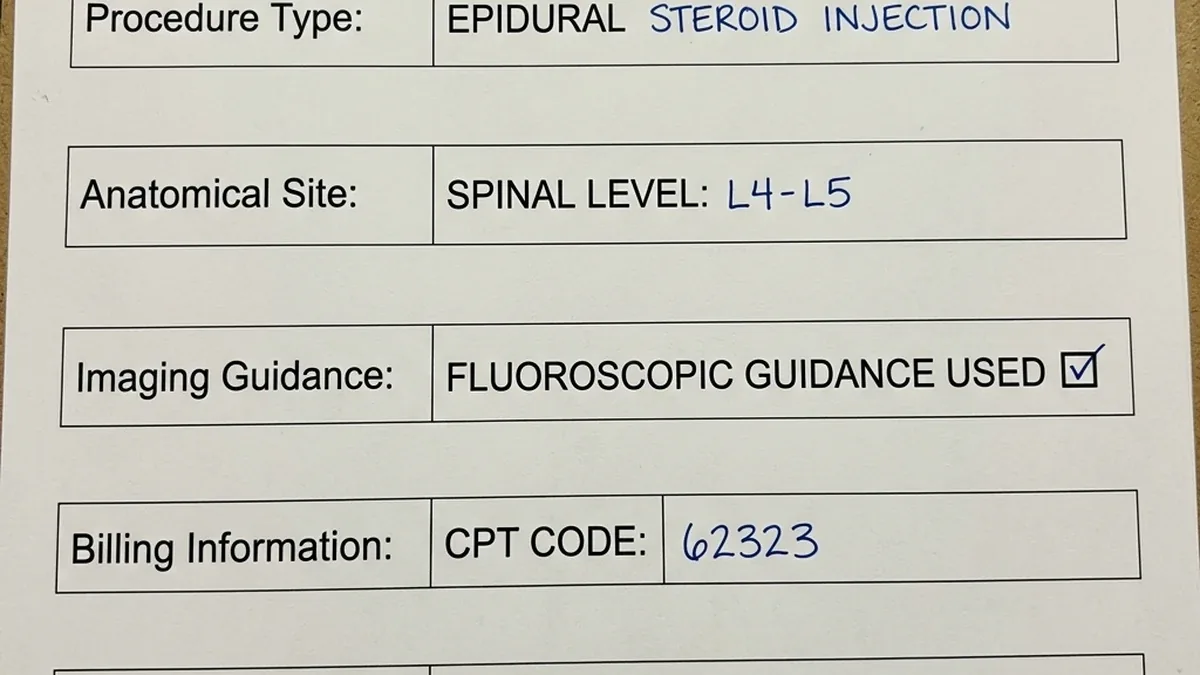
Injection codes are selected by spinal level, approach, and agent, with fluoroscopic or CT guidance codes added when imaging-assisted placement is documented in the procedure note.
Drug Code Application
Injected drug codes (J-codes) for corticosteroids, anesthetic agents, and biologic therapies are applied with correct dosage, units, and drug-to-procedure pairing.
Implant Management Billing
Spinal cord stimulator trial and implant billing, neurostimulator programming, and intrathecal pump management are coded with correct device type and session documentation.
Why This Matters for Your Revenue Cycle
Injection code specificity and imaging guidance rules applied correctly drive first-pass acceptance above 95%.
Authorization requests for interventional procedures are submitted within 48 hours of scheduling.
Every injected drug is billed with the correct J-code, dosage, and procedure pairing.
Fluoroscopic and CT guidance is billed only when documented in the operative note with clear imaging references.
Common Mistakes in Pain Management Billing Services
Billing Guidance Code Without Documentation
Fluoroscopic guidance (77003) and CT guidance (77012) may only be billed when imaging is documented in the procedure note including reference to contrast or real-time imaging confirmation of needle placement. Routine billing without documentation creates compliance exposure.
Wrong Spinal Injection Code by Level
Epidural steroid injection codes are separated by cervical/thoracic (62320-62321) and lumbar/sacral (62322-62323) approaches, with additional codes for interlaminar vs transforaminal approaches. Selecting the wrong level or approach code based on incomplete reading of the procedure note is a common error.
Missing Authorization for Major Procedures
Spinal cord stimulator trials, implants, and intrathecal pump procedures require prior authorization from virtually all commercial payers and Medicare Advantage plans. Proceeding without authorization results in denial that is difficult to reverse.
Incorrect Nerve Block Code Selection
Peripheral nerve block codes (64400-64530) are selected by named nerve or nerve plexus. Using a non-specific nerve block code when a named nerve was targeted is an undercoding error. Using a named nerve code when the injection was non-specific is an overcoding error.
How Medsure RCS Manages Pain Management Billing Services
Spinal Injection Billing
Epidural, transforaminal, and facet injection coding by level, approach, and agent with correct imaging guidance pairing.
Nerve Block Coding
Peripheral and sympathetic nerve block billing by named nerve with appropriate guidance and diagnostic vs therapeutic distinction.
SCS and Implant Management
Spinal cord stimulator trial, implant, and programming billing with correct device type and session documentation.
Intrathecal Pump Billing
Intrathecal pump implant, refill, and reprogramming billing with drug code application for intrathecal agents.
Prior Authorization Management
Systematic authorization management for the high-volume authorization requirements of interventional pain practices.
DME and Supply Billing
TENS unit, brace, and durable medical equipment billing coordinated with pain management procedure claims.
Pain Management Billing Services, Frequently Asked Questions
Multiple injections performed at different spinal levels on the same day may be separately billable depending on the code type. Bilateral facet injections at the same level use modifier 50. Injections at multiple cervical levels use the primary code plus add-on codes. We review the operative note carefully to determine the correct billing configuration.
Fluoroscopic guidance (77003) is separately billable when documented in the procedure note as actually used for needle placement confirmation. It cannot be billed as a routine addition without documentation. Some injection codes have guidance included in the base code, making a separate guidance code an NCCI violation.
The trial involves a temporary lead placement (63650), which is billed separately from the programming session and the follow-up visits during the trial period. If the trial is successful and a permanent implant is placed (63685), that is a separate procedure episode with its own code and prior authorization.
Yes. Ketamine infusion for chronic pain is billed using the infusion administration codes (96365-96368) plus the J-code for ketamine. Prior authorization is required from most commercial payers. We manage the authorization request and the infusion billing with correct drug dosage documentation.
Ask About Pain Management Billing Services
Ready to Improve Your Pain Management Billing Services?
Talk to a Medsure RCS specialist. No commitment, no pressure, just answers.
Sign up for our newsletter to receive updates, industry news, and articles about medical billing and revenue cycle management.